The Iran War's Economic Fallout
As the Iran war ripples through global markets, Americans feel the pinch at the pump, in their wallets, and on their grocery receipts. A sharp, humorous look at how conflict abroad quietly empties pockets at home.
NEWS
4/30/20265 min read
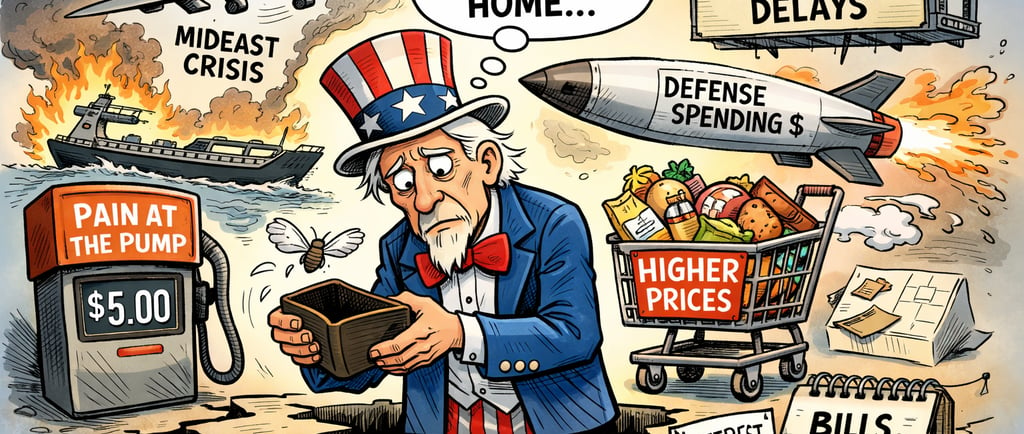
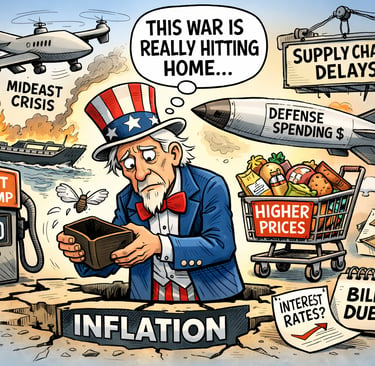
The Iran War’s Economic Fallout: America Checks Its Wallet and Finds a Post‑It Note That Says “Good Luck”
As the U.S.–Iran conflict grinds on, the economic fallout is no longer a distant policy debate — it’s showing up in gas stations, grocery aisles, and the collective American mood. Markets hate uncertainty, and nothing says “uncertain” like a widening Middle Eastern war involving global shipping lanes, oil chokepoints, and a Pentagon that keeps saying things like “operational tempo.”
The result? A slow, creeping financial squeeze that feels less like a crisis and more like a subscription you forgot to cancel — small charges adding up until suddenly you’re wondering why your bank account looks like it’s been mugged.
Oil Prices: The First Domino to Fall Over, Again
Any time the Middle East sneezes, global oil markets catch pneumonia. With the Strait of Hormuz under threat and shipping insurers charging premiums that look like ransom notes, crude prices have been climbing like they’re training for a mountain‑climbing documentary.
Consumers are feeling it immediately:
Gas prices are up.
Diesel prices are up.
And jet fuel prices are up, which means airlines are preparing their favorite coping mechanism: quietly adding $19 “operational adjustment fees” and hoping nobody notices.
Some analysts say the price spikes are temporary. Others say they’re structural. Most Americans say, “I don’t care who’s right, I just want to fill my tank without taking out a small loan.”
Supply Chains: The Sequel Nobody Asked For
Just when the world finally recovered from the Great Supply Chain Meltdown of 2020–2022, the Iran war has decided to reboot the franchise.
Shipping companies are rerouting vessels thousands of miles to avoid missile zones, drone zones, and “areas of heightened risk,” which is military‑speak for “you don’t want to be here.”
Longer routes mean:
higher shipping costs,
longer delivery times,
and the return of that familiar phrase: “Your package has been delayed due to unforeseen circumstances.”
Unforeseen? Maybe. Unwelcome? Absolutely.
Defense Spending: The One Sector Having a Great Time
While most industries are sweating, the defense sector is thriving like a cactus in a drought. Congress is approving emergency funding, contractors are ramping up production, and stock tickers for weapons manufacturers look like they’re on pre‑workout supplements.
Economists call this “countercyclical defense stimulus.” Everyone else calls it “expensive.”
Inflation: The Comeback Tour
Inflation had finally started to cool off — and then the war showed up like an uninvited guest who eats all the snacks and asks if you have more.
Higher fuel costs ripple into everything:
food transport,
manufacturing,
utilities,
and basically any product that doesn’t teleport.
The Federal Reserve is now stuck in its least favorite position: trying to decide whether to raise rates, hold rates, or simply stare into the middle distance and hope the problem solves itself.
The Big Picture: War Is Expensive, Even When It’s Far Away
The economic fallout from the Iran war isn’t dramatic or cinematic — it’s slow, steady, and annoyingly practical. It shows up in receipts, bills, and budgets. It’s the kind of economic pressure that doesn’t make headlines every day but quietly reshapes the national mood.
And the longer the conflict drags on, the more the financial strain becomes part of daily life.
For now, the U.S. economy is absorbing the shock. But the message is clear: global conflicts don’t stay “over there” for long. They always find their way into the checkout line.: America Checks Its Wallet and Finds a Post‑It Note That Says “Good Luck”
As the U.S.–Iran conflict grinds on, the economic fallout is no longer a distant policy debate — it’s showing up in gas stations, grocery aisles, and the collective American mood. Markets hate uncertainty, and nothing says “uncertain” like a widening Middle Eastern war involving global shipping lanes, oil chokepoints, and a Pentagon that keeps saying things like “operational tempo.”
The result? A slow, creeping financial squeeze that feels less like a crisis and more like a subscription you forgot to cancel — small charges adding up until suddenly you’re wondering why your bank account looks like it’s been mugged.
Oil Prices: The First Domino to Fall Over, Again
Any time the Middle East sneezes, global oil markets catch pneumonia. With the Strait of Hormuz under threat and shipping insurers charging premiums that look like ransom notes, crude prices have been climbing like they’re training for a mountain‑climbing documentary.
Consumers are feeling it immediately:
Gas prices are up.
Diesel prices are up.
And jet fuel prices are up, which means airlines are preparing their favorite coping mechanism: quietly adding $19 “operational adjustment fees” and hoping nobody notices.
Some analysts say the price spikes are temporary. Others say they’re structural. Most Americans say, “I don’t care who’s right, I just want to fill my tank without taking out a small loan.”
Supply Chains: The Sequel Nobody Asked For
Just when the world finally recovered from the Great Supply Chain Meltdown of 2020–2022, the Iran war has decided to reboot the franchise.
Shipping companies are rerouting vessels thousands of miles to avoid missile zones, drone zones, and “areas of heightened risk,” which is military‑speak for “you don’t want to be here.”
Longer routes mean:
higher shipping costs,
longer delivery times,
and the return of that familiar phrase: “Your package has been delayed due to unforeseen circumstances.”
Unforeseen? Maybe. Unwelcome? Absolutely.
Defense Spending: The One Sector Having a Great Time
While most industries are sweating, the defense sector is thriving like a cactus in a drought. Congress is approving emergency funding, contractors are ramping up production, and stock tickers for weapons manufacturers look like they’re on pre‑workout supplements.
Economists call this “countercyclical defense stimulus.” Everyone else calls it “expensive.”
Inflation: The Comeback Tour
Inflation had finally started to cool off — and then the war showed up like an uninvited guest who eats all the snacks and asks if you have more.
Higher fuel costs ripple into everything:
food transport,
manufacturing,
utilities,
and basically any product that doesn’t teleport.
The Federal Reserve is now stuck in its least favorite position: trying to decide whether to raise rates, hold rates, or simply stare into the middle distance and hope the problem solves itself.
The Big Picture: War Is Expensive, Even When It’s Far Away
The economic fallout from the Iran war isn’t dramatic or cinematic — it’s slow, steady, and annoyingly practical. It shows up in receipts, bills, and budgets. It’s the kind of economic pressure that doesn’t make headlines every day but quietly reshapes the national mood.
And the longer the conflict drags on, the more the financial strain becomes part of daily life.
For now, the U.S. economy is absorbing the shock. But the message is clear: global conflicts don’t stay “over there” for long. They always find their way into the checkout line.








Mastersgt.com is a participant in the Amazon Services LLC Associates Program. As an Amazon Associate, I may earn from qualifying purchases at no extra cost to you!
Affiliate Disclosure & Privacy Notice
Some links on this site may earn me a commission if you click or buy (consider it a small donation to the Honda Club’s imaginary lawn mower fund, lol.) For details on how your data is handled (with care and a touch of absurdity), please visit the Privacy Policy.
Copyright Notice:
All content on Mastersgt.com is protected under copyright law. Unauthorized reproduction, distribution, or use of any text, images, or other materials without explicit permission is prohibited. If you'd like to share or reference a post, please provide proper attribution.