US & IRAN NEGOTIATIONS
Diplomatic déjà vu in Doha — U.S. and Iranian envoys circle each other while Qatar plays the world’s most stressed mediator. Explore the tense, funny, and fact‑checked saga of missile diplomacy, mixed signals, and the world’s least‑comfortable peace talks.
NEWS
6/30/20263 min read
US and Iran:
Uncertainty Clouds Negotiations
(Facts sourced from AP News, Reuters, Al Jazeera, BBC, and regional reporting.)
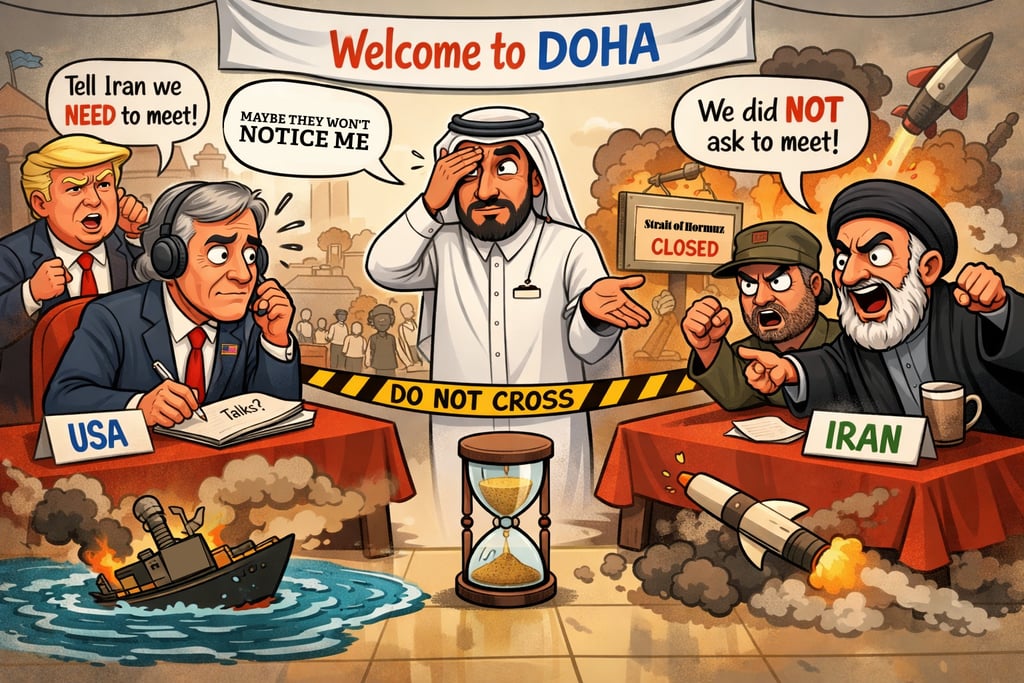
If international diplomacy had a group chat, the US–Iran negotiations in Doha would currently be full of “typing…” bubbles, unread messages, and at least one person pretending they didn’t see the last text. Because yes — U.S. envoys and Iranian officials are in the same city, but according to Qatar’s foreign ministry (as reported by Reuters), they are not meeting directly.
This is the geopolitical equivalent of attending the same wedding and asking the host to “please seat us at opposite ends of the room.”
The Setup: Everyone’s in Doha… But Nobody’s Talking
U.S. envoys Steve Witkoff and Jared Kushner arrived in Doha for high‑level discussions with Qatar’s prime minister and other mediators. Qatar clarified to Al Jazeera that the Americans are not there for direct talks with Iran.
Meanwhile, Iran’s foreign ministry told AP News that no direct negotiations with the U.S. are scheduled — despite President Trump saying publicly that Iran requested a meeting.
It’s giving me a big “I never said that” energy.
Why the Tension Is So High
The diplomatic awkwardness comes after four straight days of U.S.–Iran military exchanges, including:
Iran launching missiles and drones at U.S. sites in Kuwait and Bahrain (BBC Middle East desk)
The U.S. responding with targeted strikes (Reuters defense reporting)
A cargo ship hit near the Strait of Hormuz, prompting global shipping warnings (AP News maritime coverage)
Imagine trying to have a calm conversation with someone who threw a shoe at you two days ago. That’s the vibe.
The MoU: A Fragile Peace Agreement
A memorandum of understanding (MoU), brokered by Pakistan and Qatar, was supposed to:
Halt military operations
Reopen the Strait of Hormuz
Create a 60‑day window for broader negotiations
Address nuclear and sanctions issues
But according to Al Jazeera’s diplomatic correspondents, the talks have been dominated by arguments over who violated the ceasefire first, rather than the actual terms of the agreement.
It’s like going to couples therapy to discuss communication issues and spending the whole session arguing about dirty dishes.
So Are They Talking or Not?
Short answer: Kind of. But also not really.
The U.S. position (via Reuters): “We’re ready for high‑level and technical talks. Iran asked for this meeting.”
Iran’s position (via AP News):
“There are no negotiation meetings with the U.S. scheduled.”
Qatar’s position (via Al Jazeera):
“We’re just the hosts. Please stop yelling.”
(Paraphrased, but spiritually accurate.)
Meanwhile, Back in the Region…
While everyone insists they’re committed to “standing down,” the region looks… not very stood down.
Iran fired missiles into Kuwait and Bahrain (BBC)
The U.S. carried out additional strikes (Reuters)
Israel warned war could resume within 48 hours if missiles fly (AP News)
This is like watching two people insist they’re done fighting while actively throwing furniture.
Humor Break (Because Geopolitics Is Stressful)
A few observations to keep this readable:
Everyone is in Doha but nobody wants to talk directly.
It’s giving middle‑school dance energy — standing on opposite sides of the room, communicating only through a very stressed chaperone (Qatar).
Trump says Iran requested the meeting. Iran says it absolutely did not.
This is the international version of “I thought you wanted to hang out?”
The MoU says ‘stop attacking each other.’
Both sides: Immediately attack each other.
What Happens Next?
According to analysts quoted by Reuters and Al Jazeera, the next steps depend on:
Whether technical talks continue
Whether the ceasefire holds
Whether the Strait of Hormuz reopens without further incidents
Whether both sides stop arguing about who started it
In other words: stay tuned, because this diplomatic soap opera is still mid‑season.


Mastersgt.com is a participant in the Amazon Services LLC Associates Program. As an Amazon Associate, I may earn from qualifying purchases at no extra cost to you!
Affiliate Disclosure & Privacy Notice
Some links on this site may earn me a commission if you click or buy (consider it a small donation to the Honda Club’s imaginary lawn mower fund, lol.) For details on how your data is handled (with care and a touch of absurdity), please visit the Privacy Policy.
Copyright Notice:
All content on Mastersgt.com is protected under copyright law. Unauthorized reproduction, distribution, or use of any text, images, or other materials without explicit permission is prohibited. If you'd like to share or reference a post, please provide proper attribution.