Trumps Birthright Citizenship Bid Rejected
The Supreme Court just told Trump “Nice try” — rejecting his bid to end birthright citizenship. Dive into this fact‑checked, humor‑laced breakdown of how the 14th Amendment stayed undefeated and the Constitution got the last laugh.
NEWS
6/30/20262 min read
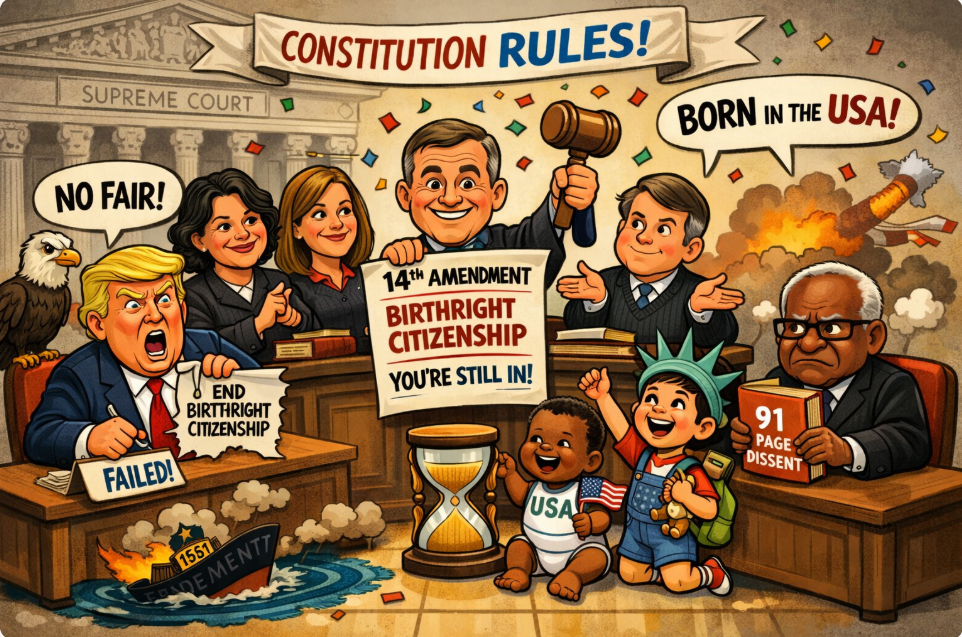
Supreme Court Rejects Trump’s Birthright Citizenship Bid
The Supreme Court has officially rejected President Trump’s attempt to end birthright citizenship — reaffirming that the 14th Amendment* still means exactly what it has meant since 1868. If you’re born on U.S. soil, you’re a U.S. citizen. No fine print. No “terms and conditions.” No “click to accept.”
This ruling came down in a 6–3 decision, as reported by The Associated Press and Reuters, with Chief Justice John Roberts writing the majority opinion. Justice Amy Coney Barrett and the Court’s three liberal justices joined him, forming an unexpectedly broad coalition.
What Trump Tried to Do
On January 1st of his second term, Trump issued an executive order aiming to end birthright citizenship for children of undocumented immigrants and temporary visa holders. According to CNN’s legal analysis, the order contradicted both constitutional text and long‑standing federal statute — which is why the Court didn’t let it stand for long.
Think of it like a New Year’s resolution: ambitious, bold, and abandoned by June.
Why the Court Said “Nope”
Roberts leaned heavily on the original intent of the 14th Amendment, citing post‑Civil War congressional debates and over a century of precedent. He even quoted the famous line that citizenship is “the right to have rights,” a phrase often referenced in constitutional scholarship.
Justice Brett Kavanaugh agreed the executive order was invalid — though for statutory rather than constitutional reasons — as noted in NPR’s breakdown of the ruling.
Justice Clarence Thomas, meanwhile, wrote a 91‑page dissent, which The New York Times described as “sweeping” and “philosophically expansive.” Ninety‑one pages! That’s not a dissent; that’s a novella.
Humor Break (Because Constitutional Law Is Dry)
A few observations to keep this fun:
The 14th Amendment remains undefeated — the Beyoncé of constitutional clauses.
Trump’s executive order lasted about as long as a gym membership in February.
Thomas’s dissent was so long it probably needed its own table of contents.
The Constitution continues to be the ultimate “You can’t sit with us” authority — except here, it’s saying everyone can sit with us if they were born here.
Why This Matters
This ruling:
Preserves a foundational definition of American citizenship
Blocks a major immigration policy initiative
Reinforces limits on executive power
Signals that even a conservative‑leaning Court won’t always align with Trump’s agenda
It’s also Trump’s second major Supreme Court defeat this year, following the decision overturning his global tariffs — a fact highlighted in Politico’s coverage.
What Happens Next
Legal scholars will debate this for years. Politicians will campaign on it. Civics teachers everywhere are breathing a sigh of relief because their PowerPoint slides don’t need updating.
Birthright citizenship remains intact. The Constitution holds steady. And the Supreme Court continues to be America’s most dramatic group project.




Mastersgt.com is a participant in the Amazon Services LLC Associates Program. As an Amazon Associate, I may earn from qualifying purchases at no extra cost to you!
Affiliate Disclosure & Privacy Notice
Some links on this site may earn me a commission if you click or buy (consider it a small donation to the Honda Club’s imaginary lawn mower fund, lol.) For details on how your data is handled (with care and a touch of absurdity), please visit the Privacy Policy.
Copyright Notice:
All content on Mastersgt.com is protected under copyright law. Unauthorized reproduction, distribution, or use of any text, images, or other materials without explicit permission is prohibited. If you'd like to share or reference a post, please provide proper attribution.